


CSC - Combustor Stability Code
CSC is a powerful software tool for predicting and analyzing combustion-driven thermoacoustic instabilities. It reconstructs combustion systems as a network model composed of multiple acoustic elements, whose acoustic behavior is described using the transfer matrix method. By solving the acoustic network model, CSC predicts the system's critical frequencies.
The software is available for Windows and Linux operating systems. Its intuitive graphical user interface and comprehensive library of thermoacoustic elements simplify model creation, analysis, and stability assessment.
CSC Workflow
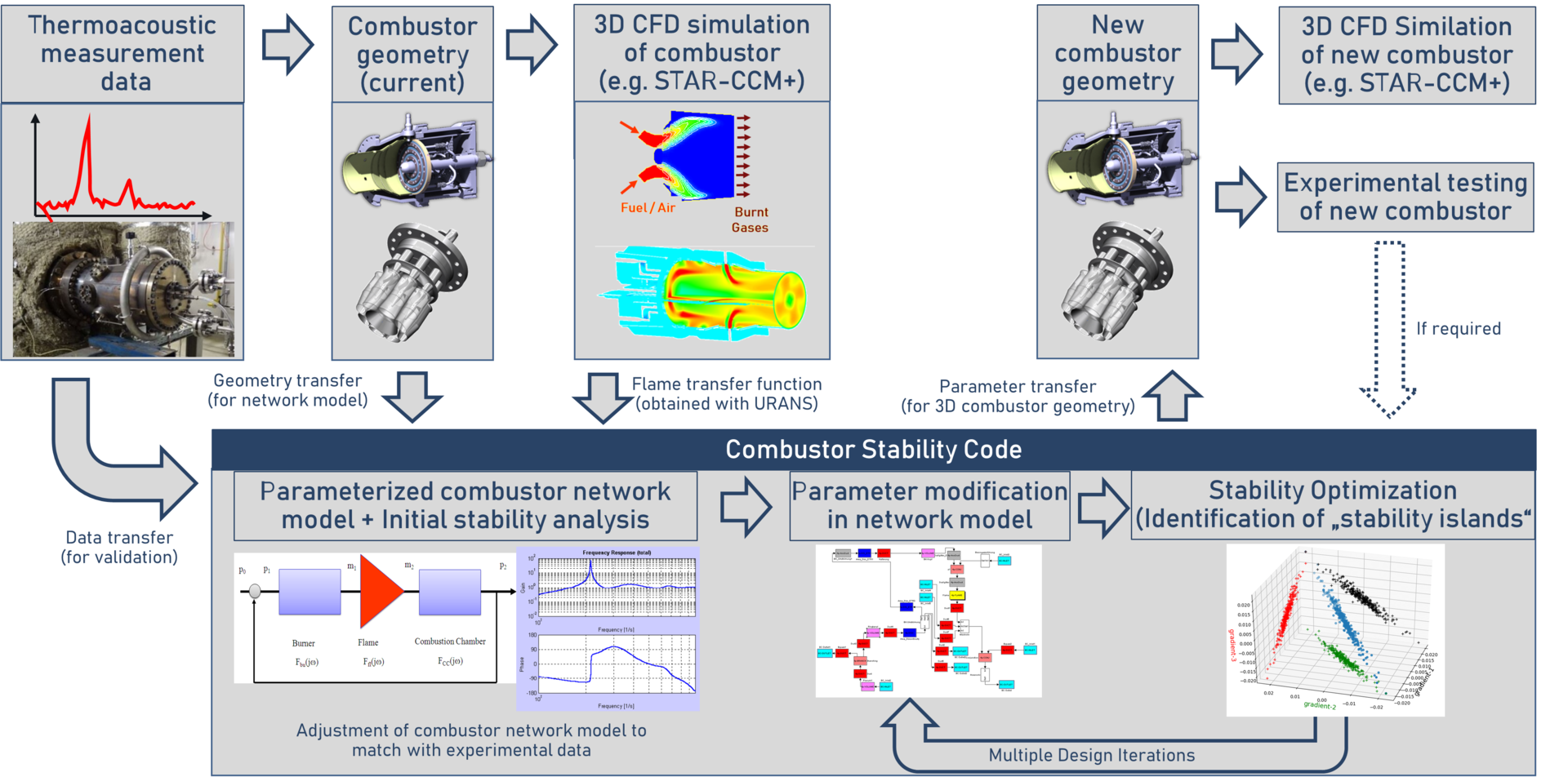
Based on the combustor geometry of interest, a parameterized network model consisting of multiple acoustic elements can be constructed in CSC. The acoustic parameters of each element can be defined and modified through the graphical interface. As a source of unsteady heat release, the flame is represented as a single element in the acoustic network. Its transfer function can be approximated using various analytical models or imported directly from experimental data or numerical simulations.
Due to the parameterized modeling approach, geometric modifications can be incorporated quickly and efficiently, allowing design changes to be evaluated with minimal effort.
CSC Software Interface
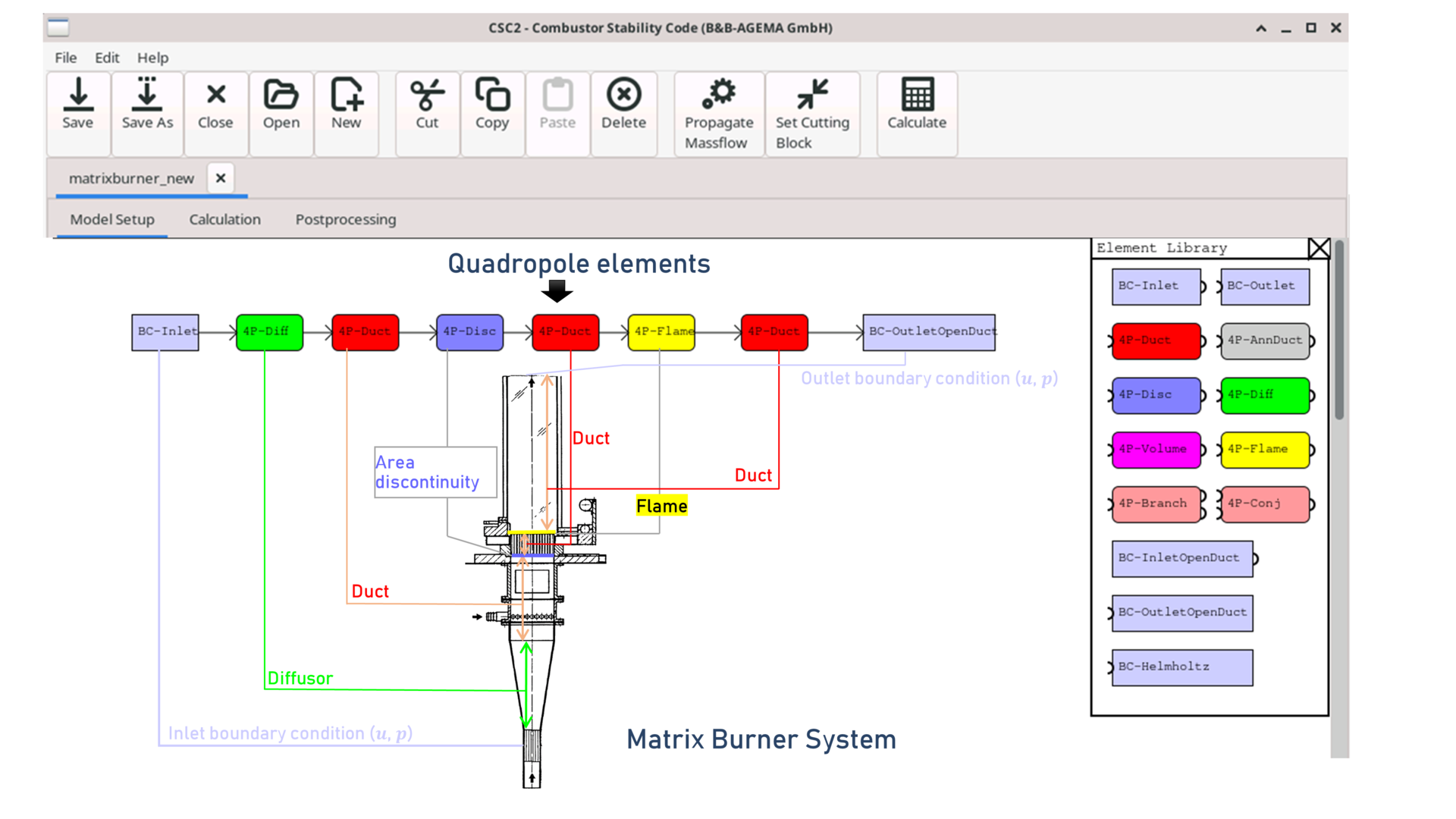
CSC enables users to build acoustic network models by simply dragging and dropping quadrupole blocks from the thermoacoustic element library into the model window.
Within the Model Setup tab, individual elements can be arranged and connected by linking their input and output ports. The library includes quadrupole models for various acoustic components of combustion systems, including ducts, annular ducts, area discontinuities, branches, conjunctions, volumes, and diffusors, as well as acoustic boundary conditions.
CSC Feature Summary
- Stability Analysis: Implements both the matrix criterion (complex eigenfrequency analysis) and the Deuker/Nyquist criterion for stability assessment.
- Model Library: Includes quadrupole models for ducts, annular ducts, area discontinuities, branches, conjunctions, volumes, diffusers, and many other acoustic components.
- Comprehensive Post-Processing: Visualizes global and local frequency responses, acoustic pressure, particle velocity, impedance, and other quantities using Bode diagrams. Results can be exported automatically for further analysis.
Sample Application
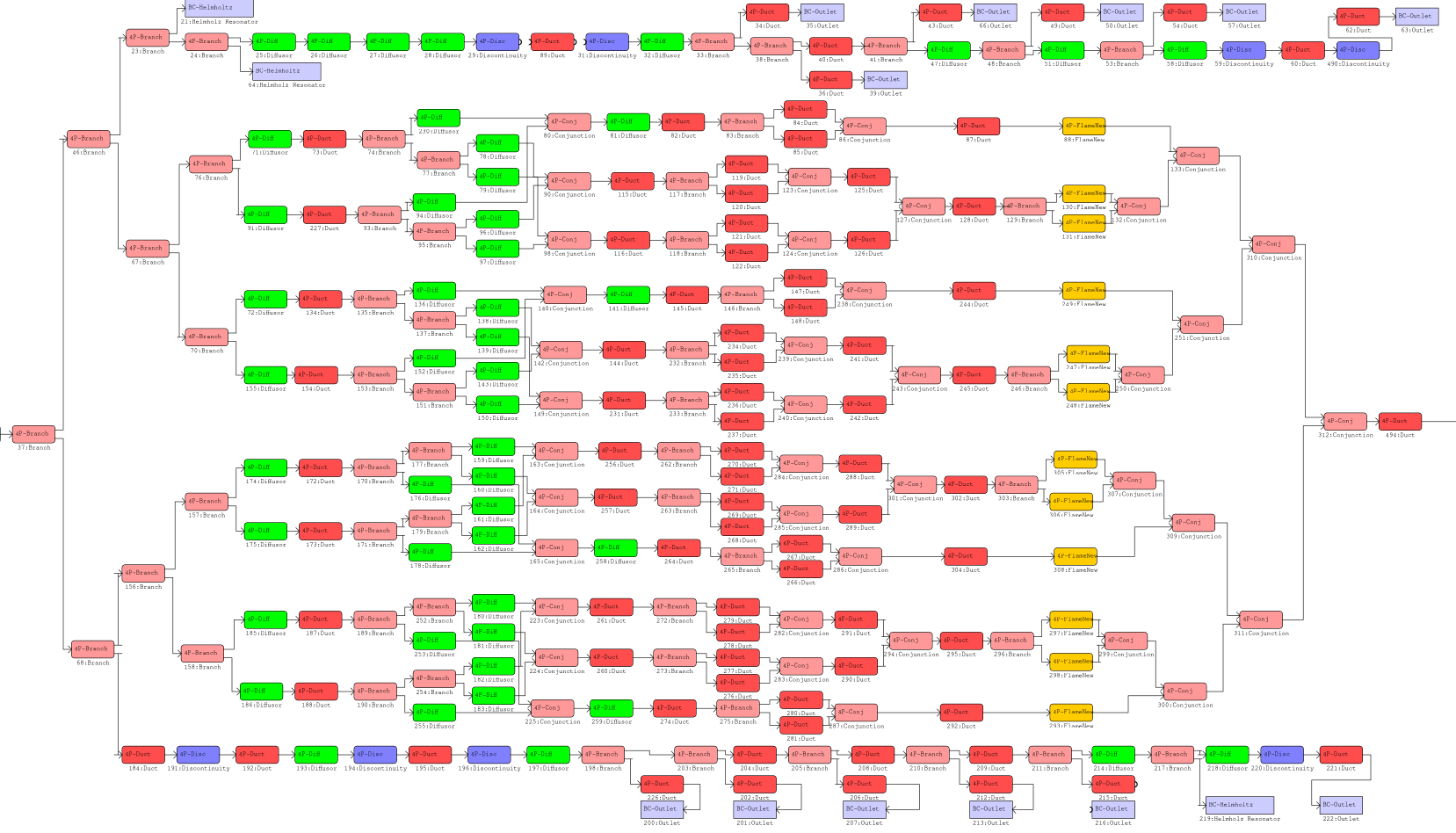
CSC can model complex, detailed thermoacoustic systems such as gas turbine combustors with multiple flames, branched fuel injectors, plenum chambers, liners, and exhaust ducts. The parameterized network approach enables rapid evaluation of design modifications and their impact on thermoacoustic stability. This makes CSC a valuable tool for supporting combustor design, optimization, and stability assessment throughout the development process.